

Stop overfitting your career by chasing every ML trend that appears on Hacker News. The machine learning field is vast, and trying to be an expert in everything leaves you mediocre at most things. Companies don’t hire generalists anymore. They hire specialists who can solve specific, high value problems that directly impact their bottom line.
The ML job market has matured significantly. Five years ago, companies hired anyone with “machine learning” on their resume. Today, they’re looking for engineers with deep expertise in particular domains. They want someone who’s built recommendation systems at scale, not someone who’s dabbled in ten different areas. They want computer vision specialists who’ve shipped models to production, not engineers who’ve completed every online course available.
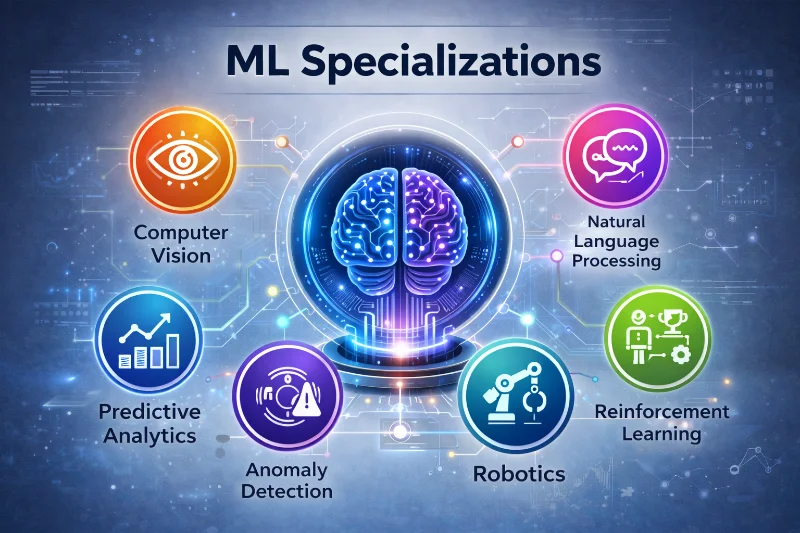
This shift creates massive opportunities for engineers who specialize strategically. Picking the right specialization can triple your job prospects and significantly increase your compensation. Pick wrong, and you’ll compete with thousands of others for the same generic roles. The difference between these outcomes comes down to understanding where demand actually exists versus where hype lives.
Key Takeaways
NLP and LLM engineering dominates hiring demand right now. Every company wants to integrate language models into their products.
Computer vision specialists remain in high demand across autonomous vehicles, healthcare, retail, and manufacturing sectors.
Recommendation systems engineers command premium salaries in e commerce, streaming, and social media companies.
MLOps and production ML expertise is the highest ROI specialization. Every company needs engineers who can deploy and maintain models.
Time series forecasting specialists are desperately needed in finance, supply chain, and energy sectors.
Reinforcement learning experts are rare and highly valued in gaming, robotics, and optimization problems.

Why Specialization Beats Generalization in ML Careers
The generalist ML engineer is becoming obsolete. Companies tried hiring jacks of all trades. They learned that broad knowledge without depth doesn’t solve real problems. A generalist might understand the theory behind transformer models, but can they actually fine tune an LLM for a specific business use case? Theory without application doesn’t move metrics.
Specialization signals expertise to hiring managers. When a company needs someone to build their recommendation engine, they want an engineer who’s done it before. They don’t want someone who’ll learn on the job. The learning curve is expensive. Production mistakes cost money. Specialists de risk hiring decisions.
The compensation difference is substantial. Generic ML engineers in mid tier markets earn $150K to $200K. Specialists in high demand areas earn $250K to $400K+. The gap reflects the value they create. A computer vision specialist who reduces manufacturing defects by 30% generates millions in savings. That impact justifies premium compensation.
Specialization also creates career insurance. When layoffs happen, specialists survive. Companies eliminate redundant roles first. If you’re one of ten generalists, you’re replaceable. If you’re the only person who understands the recommendation system that drives 40% of revenue, you’re essential.
At Ambacia, we see this pattern constantly in our placement data. Companies contact us with specific requirements. “We need a computer vision engineer with experience in medical imaging.” “We’re looking for an NLP specialist who’s worked with multilingual models.” Generic profiles don’t match these searches. Specialists do.
What Makes NLP and LLM Engineering So In Demand
Natural language processing transformed from academic research to business critical technology in just two years. Every company now wants to leverage language models. Customer service automation, content generation, document processing, code assistance. The applications are endless. The demand for engineers who can actually build these systems far exceeds supply.
The LLM Integration Wave
Companies are racing to integrate LLMs into their products. But integration is harder than it looks. You can’t just call an API and ship to production. You need to handle prompt engineering, context management, output validation, cost optimization, and latency requirements.
Engineers who understand RAG (Retrieval Augmented Generation) are particularly valuable. RAG grounds LLM outputs in factual data. It reduces hallucinations. It makes models useful for enterprise applications where accuracy matters. Building effective RAG systems requires understanding embeddings, vector databases, retrieval strategies, and how to evaluate output quality.
Fine tuning expertise is equally valuable. Many use cases need models adapted to specific domains. Medical terminology, legal language, technical documentation. Off the shelf models don’t perform well enough. Engineers who can fine tune efficiently using techniques like LoRA and QLoRA solve this problem.
Real World NLP Applications Driving Hiring
| Application Area | What Companies Need | Typical Compensation Range |
| Customer Service Automation | Intent classification, sentiment analysis, response generation | $180K – $280K |
| Document Intelligence | Information extraction, summarization, classification | $200K – $320K |
| Content Moderation | Toxicity detection, policy violation identification | $190K – $290K |
| Code Assistance | Code generation, bug detection, documentation | $220K – $350K |
| Search and Discovery | Semantic search, query understanding, ranking | $210K – $340K |
Document processing alone represents massive opportunity. Every enterprise has documents. Contracts, invoices, reports, emails. Extracting structured information from unstructured text saves countless hours. Companies pay well for engineers who can build these systems reliably.
Multilingual NLP is especially valuable. Most companies want to serve global markets. English only solutions leave money on the table. Engineers who understand cross lingual transfer learning and can deploy models that work across languages are rare. This rarity drives compensation up.
Skills That Make You Hireable in NLP
You need deep understanding of transformer architectures. Not just surface level knowledge. You should understand attention mechanisms, positional encodings, and why certain architectural choices matter for different tasks.
Experience with major frameworks is essential. Hugging Face Transformers, LangChain, LlamaIndex. Companies use these tools. You need to be productive with them immediately.
Prompt engineering is a real skill now. Knowing how to extract desired behavior from models matters. Few shot learning, chain of thought prompting, structured outputs. These techniques directly impact output quality.
Vector database experience increasingly appears in job requirements. Pinecone, Weaviate, Qdrant, Chroma. RAG systems need efficient similarity search. Understanding how to implement and optimize these systems sets you apart.
Evaluation methodologies matter as much as building models. How do you measure if an LLM output is good? Human evaluation doesn’t scale. You need automated metrics, benchmark datasets, and validation frameworks. Companies struggle with this. Engineers who solve it are valuable.

Why Computer Vision Specialists Command Premium Salaries
Computer vision applications are everywhere. Autonomous vehicles, medical imaging, retail analytics, manufacturing quality control, security systems, agricultural monitoring. Every industry wants to extract insights from visual data. The demand for engineers who can build these systems is intense.
High Value Computer Vision Applications
Autonomous vehicles represent the highest paying segment. Companies like Waymo, Cruise, Tesla, and dozens of startups need computer vision engineers. The technical challenges are immense. Real time processing, sensor fusion, edge case handling, safety critical systems. Engineers working on autonomous vehicles earn $300K to $500K+ because the problems are hard and the stakes are high.
Medical imaging is another premium area. Radiology, pathology, dermatology. AI assists doctors in diagnosis. But medical imaging requires special expertise. You need to understand clinical workflows, regulatory requirements, and interpretability. Models that can’t explain their decisions aren’t useful. Engineers who bridge technical and clinical worlds are scarce.
Retail and e commerce use computer vision extensively. Visual search, virtual try on, inventory management, checkout automation. Amazon Go stores run on computer vision. Every retailer wants similar capabilities. The ROI is clear. Reduce shrinkage, improve customer experience, optimize operations.
Manufacturing quality control offers less glamorous but highly valuable work. Detecting defects on production lines. Monitoring equipment for predictive maintenance. Ensuring product consistency. These applications directly impact profitability. A system that catches defects before shipping saves millions.
Technical Skills Companies Actually Need
| Skill Area | Specific Technologies | Why It Matters |
| Object Detection | YOLO, Faster R-CNN, RetinaNet | Core capability for most CV applications |
| Semantic Segmentation | U-Net, DeepLab, Mask R-CNN | Precise pixel level understanding |
| Video Analysis | Optical flow, action recognition, tracking | Temporal understanding beyond single frames |
| 3D Vision | Point clouds, depth estimation, SLAM | Robotics and AR applications |
| Edge Deployment | TensorRT, CoreML, ONNX | Real world deployment constraints |
Edge deployment expertise is particularly valuable. Many computer vision applications run on devices, not servers. Autonomous vehicles, mobile phones, IoT cameras. You need to optimize models to run on constrained hardware. TensorRT for NVIDIA platforms, CoreML for Apple devices, TensorFlow Lite for Android. Understanding these deployment targets and how to optimize for them separates good engineers from exceptional ones.
Data annotation and active learning matter more in computer vision than other ML areas. Labeling images is expensive and time consuming. Engineers who can minimize annotation requirements through smart sampling, transfer learning, and semi supervised techniques provide huge value. Companies spend millions on data labeling. Cut that cost by 50% and you’re a hero.
Breaking Into Computer Vision
Start with a portfolio of projects that demonstrate real skills. Build an object detection system. Implement semantic segmentation. Create something that runs in real time. GitHub repos with working code matter more than certifications.
Focus on one vertical initially. Medical imaging, autonomous vehicles, retail, manufacturing. Each has unique requirements and challenges. Depth in one area is more valuable than surface knowledge across all of them.
Contribute to open source computer vision projects. OpenCV, MMDetection, Detectron2. Real contributions build credibility. They also teach you how production quality computer vision code should look.
Ambacia regularly places computer vision engineers in roles across Europe and the US. The shortage is real. Companies compete aggressively for qualified candidates. If you have genuine computer vision expertise, particularly in high value verticals like medical imaging or autonomous systems, opportunities are abundant.
How Recommendation Systems Engineers Become Irreplaceable
Recommendation systems directly drive revenue. Better recommendations mean more engagement, more purchases, higher lifetime value. Companies measure ROI clearly. A 5% improvement in recommendation quality might mean tens of millions in additional revenue. This direct business impact makes recommendation systems engineers extremely valuable.
Why Recommendation Systems Are So Business Critical
Netflix attributes significant subscriber retention to their recommendation engine. Amazon claims 35% of revenue comes from recommendations. Spotify’s Discover Weekly keeps users engaged. YouTube’s recommendation algorithm determines what billions watch. Every platform company needs great recommendations to compete.
The challenge is harder than it appears. You’re not just predicting ratings. You’re balancing multiple objectives. Relevance, diversity, novelty, serendipity. You need to avoid filter bubbles while still giving users what they want. You’re dealing with cold start problems for new users and new items. You’re handling data sparsity, popularity bias, and feedback loops.
Real time recommendations add another layer of complexity. User context matters. Time of day, device, current session behavior, recent purchases. Your system needs to adapt instantly. Batch processing doesn’t cut it anymore. Streaming architectures, feature stores, low latency serving. The infrastructure requirements are substantial.
Technical Approaches Companies Actually Use
Collaborative filtering remains foundational. Matrix factorization, neural collaborative filtering, graph based approaches. You need to understand when each approach works best and how to implement them efficiently at scale.
Content based filtering complements collaborative approaches. Understanding item features, user profiles, and how to match them. Deep learning enabled richer content representations. Image embeddings for visual similarity, text embeddings for semantic similarity.
Hybrid systems combining multiple approaches deliver best results. Stacking, blending, cascading. You might use collaborative filtering for broad retrieval, then content based ranking, then a final neural network that learns to balance multiple signals.
| System Component | Technologies Used | Scale Considerations |
| Candidate Generation | Approximate nearest neighbors, matrix factorization | Reduce billions of items to thousands of candidates |
| Ranking | Gradient boosted trees, neural networks | Score and rank candidates by relevance |
| Re-ranking | Diversity algorithms, business rules | Ensure final recommendations meet multiple objectives |
| Serving | Redis, feature stores, model servers | Sub 100ms latency at millions of QPS |
| Evaluation | A/B testing, offline metrics | Measure actual business impact |
Two stage architectures are standard at scale. Fast candidate generation retrieves potentially relevant items from millions of options. Then slower, more sophisticated ranking models score those candidates. This balances computational cost with recommendation quality.
Exploration versus exploitation is an ongoing challenge. Pure exploitation shows users what they’re likely to engage with. But this creates filter bubbles and prevents discovery. You need strategies for introducing novelty and diversity while maintaining engagement. Multi armed bandit approaches, epsilon greedy strategies, Thompson sampling. These techniques require both theoretical understanding and practical implementation experience.
Breaking Into Recommendation Systems
Build a recommendation system from scratch. Use public datasets. MovieLens, Amazon product data, Spotify playlists. Implement multiple approaches. Show you understand the tradeoffs. Deploy it so people can actually use it. Demonstrable projects matter enormously in hiring.
Learn the major frameworks. TensorFlow Recommenders, PyTorch Geometric for graph based approaches, LightFM, Surprise. Familiarity with these tools shows you can be productive immediately.
Understand evaluation metrics deeply. Precision, recall, NDCG, MAP. But also business metrics. Click through rate, conversion rate, revenue per user, session length. Companies care about business outcomes, not just algorithmic metrics.
Study recommendation systems at major platforms. Netflix, YouTube, Amazon, Spotify publish extensively about their systems. Read their engineering blogs. Understand their architectural decisions. Learn from their mistakes and successes.
What MLOps Engineers Actually Do and Why Everyone Needs Them
MLOps is the highest ROI specialization in machine learning right now. Every company building ML systems needs MLOps expertise. The skills transfer across industries and use cases. If you’re unsure which ML specialization to choose, MLOps is the safest bet.
The MLOps Problem Companies Face
Most ML models never make it to production. Estimates suggest 80% to 90% of models stay in notebooks. The models work in development. But deploying them reliably at scale is a different challenge entirely. This gap between development and production is expensive. Wasted research effort, missed opportunities, frustrated teams.
Even models that reach production often fail quietly. Performance degrades over time. Data drift causes accuracy to drop. Nobody notices until it’s a problem. Monitoring systems don’t exist or don’t work properly. Retraining happens manually and infrequently. This operational burden is massive.
Version control for ML is harder than for software. You need to version code, data, models, configurations, and the dependencies between them. One change breaks everything. Reproducibility becomes impossible. Debugging is a nightmare.
What MLOps Actually Involves
MLOps engineers build infrastructure that makes ML reliable and scalable. They create training pipelines that run automatically. They implement monitoring systems that detect problems early. They build deployment systems that make releasing models safe and fast. They optimize infrastructure costs. They make data scientists productive.
The role requires diverse skills. Software engineering fundamentals. Distributed systems knowledge. Cloud platform expertise. Understanding of ML concepts and workflows. DevOps practices adapted for ML. It’s a broad skill set, which is why qualified MLOps engineers are scarce.
| MLOps Component | What It Includes | Business Value |
| Data Pipelines | Ingestion, validation, versioning, transformation | Reliable inputs for model training |
| Training Pipelines | Automated retraining, hyperparameter tuning, experiment tracking | Faster iteration and better models |
| Model Registry | Version control, metadata, lineage tracking | Governance and reproducibility |
| Deployment | CI/CD for models, A/B testing, canary releases | Safe rollouts and quick rollbacks |
| Monitoring | Performance metrics, data drift, model decay | Catch problems before they impact users |
| Feature Stores | Centralized feature management, online/offline consistency | Reusability and serving accuracy |
Feature stores emerged as critical MLOps infrastructure. They solve the training serving skew problem. Features computed one way in training and differently in production cause subtle bugs. Feature stores ensure consistency. They also enable feature reuse across teams. Build a feature once, use it everywhere.
Model monitoring goes beyond simple accuracy tracking. You monitor for data drift, concept drift, performance degradation. You track business metrics, not just ML metrics. You set up alerts that actually matter. You build dashboards that stakeholders understand.
Cost optimization is a major concern. Training large models is expensive. Serving predictions at scale costs significant money. MLOps engineers optimize these costs. Right sized instances, spot instances, efficient batching, model compression. A good MLOps engineer can cut infrastructure costs by 50% while maintaining or improving performance.

Learning MLOps Effectively
Start with cloud platforms. AWS SageMaker, Google Vertex AI, or Azure ML. Pick one and learn it deeply. These platforms provide MLOps infrastructure out of the box. Understanding how to use them effectively is immediately valuable.
Learn containerization and orchestration. Docker is essential. Kubernetes is increasingly expected. ML workloads run in containers. You need to be comfortable with this technology stack.
Understand CI/CD principles and adapt them to ML. GitHub Actions, GitLab CI, Jenkins. Setting up automated testing and deployment for ML systems requires different thinking than traditional software.
Study ML monitoring and observability. Prometheus, Grafana, custom logging solutions. You need to instrument ML systems properly. Know what to measure and how to measure it.
Ambacia works with numerous companies building their MLOps capabilities from scratch. The demand far exceeds supply. Companies struggle to find engineers with this skill set. If you develop strong MLOps expertise, you’ll have more opportunities than you can pursue.
Where Time Series Forecasting Specialists Find Opportunities
Time series forecasting is less glamorous than computer vision or NLP. It doesn’t generate headlines. But companies need it desperately. Finance, supply chain, energy, retail, healthcare. Any business with temporal data needs forecasting. The applications are endless and the demand is strong.
Industries Desperate for Time Series Expertise
Finance and trading firms are the highest paying segment. Predicting stock prices, trading volumes, market volatility. High frequency trading relies on accurate short term forecasts. Risk management requires modeling extreme events. Algorithmic trading strategies need forecasting at their core. Compensation at top firms easily exceeds $300K for experienced time series specialists.
Supply chain and logistics need forecasting for demand planning, inventory optimization, and resource allocation. Retail companies forecast sales to manage inventory. Manufacturing companies forecast demand to plan production. Transportation companies forecast package volumes to allocate capacity. Poor forecasting means lost revenue or wasted resources. Good forecasting drives profitability.
Energy sector forecasting is unique and valuable. Electricity demand varies by hour and season. Renewable energy production depends on weather. Grid operators need accurate forecasts to balance supply and demand. Energy trading requires predicting prices. Smart buildings optimize HVAC based on occupancy forecasts. This domain has specific technical challenges and regulatory requirements.
Healthcare applications range from predicting patient admissions to forecasting disease outbreaks. Hospitals need to staff appropriately. Pharmaceutical companies forecast drug demand. Public health agencies track epidemic trends. These applications often have life or death implications.

Technical Approaches That Matter
Classical time series methods still matter. ARIMA, exponential smoothing, seasonal decomposition. These techniques are well understood and often work surprisingly well. Many modern approaches benchmark against them. You need to know when simple methods suffice before deploying complex neural networks.
Machine learning brought new capabilities. Gradient boosted trees (XGBoost, LightGBM) handle multiple features naturally. They capture non linear relationships. They work well with irregular time series. Many winning Kaggle solutions use these approaches.
Deep learning for time series has matured significantly. LSTMs, GRUs, and Transformer based models handle long sequences. They can learn complex temporal patterns. Temporal Fusion Transformers, N-BEATS, DeepAR. These architectures specifically designed for forecasting outperform generic approaches.
| Forecasting Challenge | Effective Approaches | Industry Examples |
| High frequency short term | LSTM, attention mechanisms | Trading, energy grid management |
| Long term seasonal | Prophet, SARIMA, hybrid models | Retail demand planning |
| Multiple related series | Hierarchical models, graph neural networks | Supply chain across locations |
| Irregular sampling | Interpolation, neural ODEs | Healthcare, sensor networks |
| Extreme events | Quantile regression, extreme value theory | Risk management, insurance |
Probabilistic forecasting is increasingly required. Point forecasts aren’t enough. Stakeholders need uncertainty estimates. Prediction intervals, quantile forecasts, full predictive distributions. Techniques like conformal prediction provide principled uncertainty quantification.
Multivariate forecasting with related series is common. You’re not forecasting one time series in isolation. You have sales across multiple products, locations, and time periods. Or you have sensor readings from different devices. Approaches that leverage relationships between series outperform treating each independently.
Building Time Series Expertise
Work with real world datasets. Kaggle competitions provide good practice. M5 forecasting competition, COVID-19 forecasting challenges, energy forecasting competitions. These datasets have real characteristics. Missing values, seasonality, trend changes, outliers.
Learn the major libraries and frameworks. Statsmodels for classical methods. Prophet for additive models with seasonality. GluonTS and PyTorch Forecasting for deep learning. Familiarize yourself with their APIs and when to use each.
Understand evaluation metrics specific to forecasting. MAE, RMSE, MAPE, symmetric MAPE. But also business relevant metrics. Inventory costs, trading profit, energy imbalance penalties. Connect technical metrics to business outcomes.
Study domain specific forecasting challenges. Finance has different requirements than retail. Energy forecasting faces unique constraints. Healthcare forecasting has regulatory considerations. Pick a domain and go deep.
Why Reinforcement Learning Experts Are So Rare and Valuable
Reinforcement learning remains the most challenging ML specialization. It’s harder to learn, harder to apply, and harder to get working reliably. This difficulty creates scarcity. Companies need RL expertise but can’t find it easily. This supply demand imbalance drives exceptional compensation for qualified engineers.
Where RL Actually Gets Applied
Gaming is the most visible application. AlphaGo, OpenAI Five, DeepMind’s StarCraft agents. Game companies use RL for NPC behavior, difficulty adjustment, and game testing. But this represents a small fraction of RL opportunities.
Robotics relies heavily on RL. Training robots to manipulate objects, navigate environments, or collaborate with humans. Simulation based training then transfer to real world. Companies building industrial robots, warehouse automation, or service robots need RL expertise.
Recommendation systems increasingly use RL formulations. User engagement is a long term reward, not immediate feedback. RL approaches can optimize for lifetime value rather than next click. This application area is growing rapidly.
Resource optimization problems suit RL naturally. Data center cooling optimization. Cloud resource allocation. Traffic light control. Network routing. These sequential decision making problems under uncertainty map well to RL frameworks.
Autonomous systems beyond just vehicles use RL. Drones, underwater vehicles, spacecraft. Any system that needs to learn from interaction with complex environments potentially benefits from RL approaches.
Why RL Is So Challenging
The feedback loop is different from supervised learning. You don’t have labeled examples. You have rewards that might arrive after many actions. You need to balance exploration and exploitation. You face credit assignment problems. Which actions led to which outcomes?
Sample efficiency is a major challenge. RL algorithms often need millions of environment interactions to learn. This works in simulation but is prohibitive in real world systems. Recent advances in sample efficient RL help but haven’t solved the problem.
Reward design is notoriously difficult. Specify the wrong reward and your agent learns the wrong behavior. Classic example: a robot learns to fall over to avoid walking because falling gives no negative reward. Reward shaping and inverse reinforcement learning help but require expertise.
Stability and reproducibility are harder than in supervised learning. Small hyperparameter changes cause large performance differences. Random seeds matter more. Results are harder to reproduce. This frustrates researchers and makes production deployment challenging.
Building RL Skills
Start with simulated environments. OpenAI Gym provides standard benchmarks. MuJoCo for physics simulation. Unity ML Agents for game like environments. You need somewhere to train policies without real world consequences.
Implement algorithms from scratch at least once. Policy gradients, DQN, A3C, PPO, SAC. Understanding the math and implementation details matters in RL more than other ML areas. You’ll debug issues that require this deep understanding.
Study successful applications. Read DeepMind and OpenAI papers. AlphaGo, AlphaStar, Dactyl, OpenAI Five. Understand their architectural choices, reward structures, and training procedures. Learn from proven approaches.
Focus on one application domain. Robotics, game AI, or optimization problems. Each has unique considerations. Depth in one area is more valuable than surface knowledge across all RL.
Ambacia occasionally places RL specialists but acknowledges the niche nature of these roles. If you develop genuine RL expertise, opportunities exist but are more concentrated in specific companies. Research labs, robotics companies, large tech firms with advanced AI teams. The positions are fewer but competition is also limited.

How to Choose Your ML Specialization Strategically
Choosing a specialization is a strategic career decision. Pick right and doors open. Pick wrong and you struggle to find opportunities. Several factors should guide your decision.
Align With Your Interests and Strengths
You’ll spend years developing deep expertise. Choose something you actually enjoy. If working with text and language excites you, pursue NLP. If visual problems fascinate you, go into computer vision. Sustained interest matters for long term success.
Consider your existing skills and background. Software engineers often transition well into MLOps. It leverages their infrastructure expertise. Statisticians might gravitate toward time series forecasting. Mathematics heavy backgrounds suit reinforcement learning. Build on your strengths.
Your domain knowledge affects specialization choice. Healthcare background makes medical imaging natural. Finance experience helps with time series forecasting in markets. E commerce experience provides context for recommendation systems. Domain expertise combined with ML skills is powerful.
Evaluate Market Demand Realistically
Some specializations have more openings than others. NLP and MLOps have the broadest opportunities currently. Computer vision and recommendation systems have strong demand in specific industries. Time series forecasting has steady demand but less hype. RL has limited but high paying opportunities.
Geographic location matters. Computer vision jobs concentrate around autonomous vehicle hubs. Fintech time series roles cluster in financial centers. Remote work expanded options but some specializations have more remote opportunities than others.
Consider industry trends. LLM integration is hot now but might saturate in 2 to 3 years. MLOps demand will likely stay strong as more companies productionize ML. Computer vision applications keep expanding to new industries. Try to see beyond current hype to sustainable demand.
Factor in Learning Curve and Barriers to Entry
Some specializations are easier to break into than others. NLP with modern LLMs has a gentler learning curve. You can build useful applications quickly. MLOps requires broad skills but each piece is learnable. Time series forecasting has well established methods and clear evaluation.
Computer vision requires significant study but has abundant learning resources. Reinforcement learning has the steepest learning curve and is hardest to practice without simulation environments.
Consider the time investment required. Could you develop junior level competency in 6 months? Intermediate skills in 18 months? Expert level in 3 to 5 years? Your current situation affects what’s realistic.
Long Term Career Trajectory
Think about where each specialization leads. MLOps can lead to ML infrastructure roles or ML platform teams. Computer vision can lead to robotics or autonomous systems. NLP specialists might transition to AI product roles. Time series forecasting can lead to quantitative roles in finance.
Some specializations have clearer advancement paths than others. Consider whether you want to stay deeply technical or eventually move toward leadership. Some specializations prepare you better for principal engineer or architect roles. Others position you for technical leadership.
Salary trajectories differ across specializations. RL specialists at top companies can exceed $500K but opportunities are limited. MLOps engineers have more opportunities but slightly lower peak compensation. NLP roles span the widest range depending on the application and company.
At Ambacia, we guide candidates through these considerations regularly. The right specialization depends on your unique situation. Your skills, interests, location, career goals, and market timing all factor in. What works for one engineer might not work for another. The key is making an informed, strategic choice rather than following hype.
Take Action on Your ML Specialization Today
You now understand which ML specializations companies desperately need. NLP and LLM engineering, computer vision, recommendation systems, MLOps, time series forecasting, and reinforcement learning. Each offers strong career prospects for engineers who develop genuine expertise.
The next step is choosing your path and committing to it. Stop spreading yourself thin across every ML subdomain. Pick one specialization that aligns with your interests and market demand. Go deep rather than wide.
Build a portfolio that demonstrates real expertise. Companies hire based on what you’ve done, not what courses you’ve completed. Ship projects. Contribute to open source. Write about what you’re learning. Make your expertise visible.
Network within your chosen specialization. Join communities, attend conferences, follow thought leaders. The ML field is small enough that reputation matters. People hire engineers they know or who come recommended by trusted sources.
Ready to explore opportunities in your chosen ML specialization? Ambacia connects specialized ML talent with companies across Europe and globally. We work with organizations actively hiring for NLP, computer vision, MLOps, and other ML specializations. Whether you’re exploring your first specialized role or ready to make a senior level move, we can help you find opportunities that match your expertise and career goals. Let’s discuss how your specialization fits the current market and where you can make the biggest impact.

FAQ
1. Which ML specialization has the highest demand right now?
NLP and LLM engineering currently leads in hiring demand. Every company wants to integrate language models into their products. Customer service automation, document processing, content generation, and code assistance applications are driving this demand.
MLOps follows closely behind. Every organization deploying ML systems needs engineers who can build reliable production infrastructure. The gap between research and production creates massive opportunity for MLOps specialists.
Computer vision maintains strong demand across multiple industries. Autonomous vehicles, medical imaging, retail analytics, and manufacturing quality control all need computer vision expertise. The applications are diverse and well funded.
Market demand shifts over time. LLM integration might saturate in 2 to 3 years as more engineers develop these skills. MLOps demand will likely remain strong longer because it applies to all ML systems regardless of the specific technique.
If you’re deciding which specialization to pursue, consider both current demand and long term sustainability. Working with specialized IT recruitment agencies like Ambacia can provide insights into hiring trends and which specializations are seeing the most active recruitment in your target geographic market.
2. How long does it take to become job ready in an ML specialization?
The timeline varies significantly based on your starting point and chosen specialization. If you have strong software engineering fundamentals and basic ML knowledge, you can reach junior competency in 6 to 9 months with focused study and practice.
MLOps and recommendation systems might be fastest to break into if you have software engineering background. You’re building on existing skills. NLP with modern LLMs also has a relatively gentle learning curve because you can quickly build useful applications using pre trained models.
Computer vision typically requires 12 to 18 months to develop job ready skills. The field has depth and you need to understand various architectures and their tradeoffs. Time series forecasting is similar, requiring deep understanding of statistical methods and modern deep learning approaches.
Reinforcement learning has the steepest learning curve. Expect 18 to 24 months minimum to develop genuine competency. The mathematical foundations are demanding and practical experience requires simulation environments.
Intermediate to senior level expertise takes longer. Plan on 2 to 3 years of focused work to develop the deep expertise that commands premium salaries. This includes shipping production systems, handling edge cases, and developing intuition for what works in practice versus theory.
3. Can I switch between ML specializations later in my career?
Yes, switching specializations is possible but becomes more difficult as you progress. Early in your career, you have more flexibility. With 2 to 3 years of experience, transitioning to a different specialization is straightforward. You have ML fundamentals and one area of depth. Learning another is manageable.
Mid career transitions require more justification. With 5+ years in computer vision, switching to NLP means competing with people who have years of NLP specific experience. You’ll likely take a step back in seniority and compensation initially. But your ML maturity transfers. You’ll progress faster than someone entirely new to ML.
Related specializations are easier to bridge. MLOps engineers can transition to ML platform engineering. Computer vision specialists can move into robotics. NLP engineers can shift focus from traditional methods to LLM applications. These transitions leverage existing knowledge.
Some skills transfer across all specializations. Production deployment, monitoring, evaluation methodologies, cloud infrastructure. Building these foundational capabilities early provides flexibility later.
The best strategy is picking a specialization you can commit to for at least 3 to 5 years. Develop genuine expertise before considering a switch. Shallow knowledge across multiple areas is less valuable than depth in one.
4. Do I need a specific degree to specialize in ML areas like computer vision or NLP?
No specific degree is required for most ML specializations. Computer science, mathematics, statistics, physics, and engineering backgrounds all work. What matters is your ability to learn the required concepts and build production systems.
Computer vision and NLP benefit from strong mathematical foundations. Linear algebra, calculus, probability, and statistics are essential. If your degree covered these topics, you have a solid starting point. If not, you’ll need to fill those gaps through self study.
MLOps cares more about software engineering skills than advanced mathematics. Distributed systems, cloud platforms, and DevOps practices matter more. Software engineers without ML backgrounds can transition into MLOps more easily than into research heavy specializations.
Time series forecasting benefits from statistics background. Econometrics, signal processing, or quantitative fields provide relevant preparation. But you can learn the necessary statistics through dedicated study.
Reinforcement learning is the most mathematically demanding specialization. Control theory, optimization, and probability theory are fundamental. A degree touching these areas helps but isn’t mandatory if you’re willing to study independently.
Practical experience outweighs credentials past entry level. Once you have 2+ years shipping production systems, nobody asks about your degree. They care about what you’ve built and the impact you’ve created.
5. Which ML specialization offers the best work life balance?
Work life balance varies more by company and team than by specialization. That said, some patterns exist across specializations.
MLOps roles often have on call responsibilities. Production systems break at inconvenient times. If you’re maintaining critical ML infrastructure, you might handle incidents outside regular hours. However, mature MLOps organizations rotate on call duties and build reliable systems that rarely break.
Recommendation systems and time series forecasting typically offer better work life balance. The work is important but rarely urgent. You’re optimizing systems that already function. Deadlines exist but are usually predictable.
Computer vision for autonomous vehicles can be demanding. Safety critical systems and competitive pressure create intense environments. Medical imaging tends to have more reasonable hours unless you’re at a fast growing startup.
NLP and LLM engineering varies widely. Startups racing to ship LLM applications often have intense crunch periods. Established companies integrating LLMs into existing products typically have more sustainable pace.
Reinforcement learning research roles might have the most flexibility. You’re solving hard problems with long timelines. Daily hours matter less than making progress. However, positions are limited.
Company culture impacts balance more than specialization. A mature company with good engineering practices offers better balance regardless of specialization. Early stage startups in any specialization tend to be demanding.
6. How much do ML specialists earn compared to general ML engineers?
ML specialists earn significantly more than generalists. The gap widens with experience. At entry level, the difference might be 10% to 20%. At senior levels, specialists can earn 50% to 100% more than generalists.
General ML engineers at mid tier companies earn $150K to $200K total compensation. Specialists in high demand areas earn $250K to $400K+. The gap reflects the value they create and their scarcity in the market.
Specific specializations command different premiums. Reinforcement learning specialists at top companies can exceed $500K but opportunities are limited. Computer vision engineers working on autonomous vehicles earn $300K to $500K. NLP specialists with LLM expertise currently see strong demand and compensation in the $250K to $400K range.
MLOps specialists earn $220K to $350K depending on company and location. Time series forecasting specialists in finance earn $280K to $450K. Recommendation systems engineers at major platforms earn $260K to $400K.
These ranges include base salary, equity, and bonuses. Geographic location significantly impacts numbers. San Francisco and New York pay more. European markets pay less than US markets but the gap is narrowing for remote positions.
At Ambacia, we see consistent data showing specialists receive 30% to 50% higher offers than generalists with similar years of experience. The market rewards depth over breadth at every experience level.
7. Should I learn multiple ML specializations or focus on just one?
Focus on one specialization first. Develop genuine expertise before broadening. Depth creates career opportunities and commands premium compensation. Breadth is useful but secondary.
Plan for 2 to 3 years focused on your primary specialization. Build production systems. Handle edge cases. Develop intuition. Become someone who can solve hard problems in that domain. This depth makes you hireable and valuable.
After establishing depth, strategic breadth makes sense. Adding complementary skills increases your impact. An NLP specialist who understands MLOps can deploy their own models. A computer vision engineer who learns recommendation systems can build visual search. But add breadth to enhance your specialization, not dilute it.
Some foundational skills apply across specializations. Production deployment, monitoring, cloud platforms, evaluation methodologies. Invest in these regardless of specialization. They multiply your effectiveness.
Avoid the trap of collecting superficial knowledge across many areas. Companies don’t hire engineers who’ve taken every course but haven’t shipped anything. They hire specialists who’ve solved real problems in production.
The market rewards T shaped skills. Deep expertise in one area (the vertical bar) with broad understanding of related areas (the horizontal bar). Focus on developing that vertical depth first.
8. What resources are best for learning ML specializations?
Learning resources vary by specialization but some patterns apply. Start with foundational courses to understand theory. Then move quickly to practical projects. Reading research papers helps but shouldn’t dominate your time.
For NLP and LLMs, Hugging Face documentation and tutorials are excellent. Build applications using pre trained models. Fine tune models for specific tasks. The official Transformers course covers modern NLP comprehensively. Follow research from Anthropic, OpenAI, and Google on LLM developments.
Computer vision learners should study the FastAI course and Stanford’s CS231n. Implement architectures from scratch at least once. Work with real image datasets. Kaggle competitions provide good practice with realistic problems.
MLOps requires broad learning. Start with one cloud platform deeply. AWS Machine Learning Specialty or Google Professional ML Engineer paths work well. Read “Machine Learning Engineering” by Andriy Burkov. Follow engineering blogs from Netflix, Uber, and Airbnb describing their ML infrastructure.
Time series forecasting benefits from both classical and modern approaches. Rob Hyndman’s “Forecasting: Principles and Practice” covers statistical methods. Then learn modern deep learning approaches through PyTorch Forecasting documentation and GluonTS tutorials.
Reinforcement learning demands strong theoretical foundation. Sutton and Barto’s “Reinforcement Learning: An Introduction” is essential. OpenAI Spinning Up provides practical implementations. Work through simulated environments before attempting real world applications.
Books, courses, and tutorials build knowledge. But projects build skills. Spend 70% of your time building and 30% studying. This ratio accelerates practical competency.
9. How do I know which ML specialization fits my background and skills?
Your existing skills and background suggest natural fits. Software engineers transition well into MLOps. Your infrastructure and deployment experience directly applies. The learning curve focuses on ML specific challenges rather than software fundamentals.
Data scientists often move into time series forecasting or recommendation systems. Your statistical background and business context understanding provide advantages. You’re adding production engineering skills to analytical capabilities you already have.
Mathematics and physics backgrounds suit computer vision and reinforcement learning. These specializations are mathematically intensive. Your quantitative training accelerates learning complex algorithms and their theoretical foundations.
Domain expertise influences specialization choice. Healthcare background makes medical imaging natural. Finance experience helps with time series forecasting in markets. E commerce experience provides context for recommendation systems. Combining domain knowledge with ML skills creates powerful differentiation.
Consider what types of problems excite you. If language and communication fascinate you, pursue NLP. If visual information processing interests you, choose computer vision. If building reliable systems satisfies you, focus on MLOps. Sustained interest over years requires genuine curiosity about the problem domain.
Ambacia helps candidates assess specialization fit regularly. We look at your background, skills, interests, and target companies. The right specialization aligns your strengths with market demand and personal interests. This alignment accelerates learning and career progression.
10. Are ML specializations stable career choices or will they become obsolete?
ML specializations are stable career choices for the foreseeable future. The field is maturing, not contracting. Demand for specialized ML expertise continues growing as more companies deploy AI systems in production.
Some concern exists about AI tools automating ML engineering itself. GitHub Copilot and similar tools help engineers write code faster. They don’t replace the judgment needed for production systems. Someone still needs to design architectures, choose appropriate techniques, deploy reliably, and maintain systems.
Specific techniques within specializations evolve. Computer vision moved from hand crafted features to deep learning. NLP moved from statistical models to transformers to LLMs. But the core problems remain. Companies still need visual understanding, language processing, and accurate predictions.
MLOps becomes more important as ML adoption increases. Every company deploying models needs production infrastructure. This specialization has long runway because it applies regardless of which ML techniques are popular.
The engineers most future proof are those who focus on solving business problems rather than mastering specific tools. Tools change constantly. The ability to identify valuable problems, choose appropriate solutions, and deliver production systems remains valuable.
Some specializations have longer runways than others. MLOps, computer vision, and time series forecasting address fundamental needs that aren’t going away. LLM engineering specifically might transform as the technology matures, but NLP broadly will remain relevant.
Career insurance comes from depth plus adaptability. Develop deep expertise in one area. Build strong fundamentals that transfer across techniques. Stay current with new developments. This combination creates resilient careers regardless of how specific technologies evolve.
The ML job market changes quickly. Working with agencies like Ambacia that track market trends helps you stay informed about which specializations are growing versus saturating.



